How Books Help us Grow

Stack of books with blurred bookshelf background, reading, learning, education or home office concept Stack Stock Photo

I have been an avid reader ever since I was able to read independently.  As a kid, I devoured books — The Trixie Belden series, books in my school library about suffragists, Little Women, Judy Blume and Judith Viorst books — anything I could get my hands on.  As I got older, my love of reading influenced my career choice.  I became an English teacher then a school librarian because of my love of books.  From a very early age, I understood the powerful effect books have on a reader.  For me, books offered escape, knowledge, and insight into life; books changed me.

Last summer, I read a book by Cheryl Strayed.  The book was Tiny Beautiful Things, and it’s a book filled with posts from her advice column Dear Sugar.  You might immediately think of a Dear Abby situation, which strangely enough, I read voraciously as a kid, but Cheryl (Sugar) goes much deeper than Abby ever did.  Cheryl shows compassion with her responses and calls people out in a gentle way.  When you read her book, you can tell that she really ponders each situation and responds with wisdom and honesty. 

In this book, there was a letter from a dad who lost his 22 year old son.  I immediately wanted to reach out to this dad, although this was written more than ten years ago and there’s no way for me to find out who this man is.  His letter slayed me.  But then Sugar’s response really hit home.  Here are some things she said that resonated with me, and maybe they’ll resonate with you as well:

“My grief is tremendous but my love is bigger.”  

“Your boy is dead, but he will continue to live within you.  Your love and grief will be unending, but it will also shift in shape.”

“More will be revealed.  Your son hasn’t yet taught you everything he has to teach you.  He taught you how to feel like you’ve never loved before.  He taught you to suffer like you’ve never suffered before.  Perhaps the next thing he has to teach you is acceptance.  And the thing after that, forgiveness.”  

“You go on doing the best you can.  You go on by being generous.  You go on by being true.  You go on by offering comfort in others who can’t go on.  You go on by allowing the unbearable days to pass and allowing the pleasure in other days.  You go on by finding a channel for your love and another for your rage.”   This has become one of my favorite quotes. 

“…Grief taught me things.  It showed me shades and hues I couldn’t have otherwise seen.  It required me to suffer.  It compelled me to reach.”

Strayed’s book, as well as many other books I’ve read over the years, help me when I’m down, when I’m experiencing a wave of grief, when I’m just trying to figure out the world.   I want to share with you some  phenomenal books that, over the years,  have impacted me and the way I see the world.  

  1. Remembering the Good Times by Richard Peck.  When I began my degree as an English major, I had this weird idea that the books I read should all be classics.  Then, I enrolled in a YA Lit class and I read this book.  It was the first (and definitely not the last) YA book that made me cry.  Since then, I’ve been a big YA reader and believe that there are lots of great lessons to be found in YA fiction.   
  1. Running Loose by Chris Crutcher.  This is probably my all-time favorite YA book, and I think EVERYONE should read it.  In fact, after I read this back in college, I made my dad, my sister, and my future husband read it.  This book is about family, love, and standing up for what is right, and you just can’t help empathizing with the main character, Louie, who gets mistreated after trying to do the right thing.  Since reading this, I’ve devoured all of Crutcher’s books, and they are all very moving and appealing to both young adults and adults like myself.  
  1. The Grapes of Wrath by John Steinbeck.  I first read this book in college, and then I taught it in my Junior English class .  I love the “I to we” theme — the idea that society works better when we lend a hand to those who are struggling.  I know that this novel is long, it’s very descriptive, it’s probably not for everyone.  However, I see The Grapes of Wrath as a beautifully written historical fiction work that continues to teach me about the nature of humanity..
  1. The Glass Castle by Jeanette Walls.  I remember the first time I read this a few years ago, and I couldn’t stop talking about it.  Walls’  memoir  is extremely powerful.  As a parent, I could not even fathom the level of neglect the children in the story experienced.  I admire Ms. Walls for removing herself from a toxic family situation and for having the courage to share her story.  
  1. Wangari’s Trees of Peace:  A True Story of Africa by Jeanette Winter.  This is a picture book/biography about Wangari Mathaai, a scholar/environmentalist from Kenya.  Every year I read this to my 2nd graders around Earth Day.  It’s both sad and uplifting, with brilliant illustrations that add to the message of the book.  Although this is a children’s book, I highly recommend you take a look or read about Wangari Mathaai.  She was an amazing human, a Nobel Peace Prize winner, and someone you may know very little about.
  1. Junkyard Wonders by Patricia Polacco.  I love this book. It’s one I read again and again and again to my students, and every time I get choked up.   Junkyard Wonders is the story of a teacher, Mrs. Peterson, who teaches the kids who don’t quite fit in a traditional classroom.  The other kids see Mrs. Peterson’s students as “junk,”, but Mrs. Peterson sees them all as wonders. It’s a beautiful story about a class that forms a lifelong bond and, in the process, learns to never give up.  
  1. In the Wild Light by Jeff Zentner.  I read this in 2022, and I have been talking about it ever since.  It’s a YA novel that is beautifully written; in fact, it is prose that feels more like poetry.  The story is about a boy growing up in Appalachia, being raised by his grandparents.  He gets the opportunity to attend a boarding school on the East Coast with his best friend, and this changes his life.  In the Wild Light is about family, friendship, love, and becoming the person you were meant to be.  

The point of this list is to show how books can impact readers and how books impacted me.  Each of these books has taught me something valuable and presented me a different perspective on life. These works have inspired me, allowed me to work through my own emotions, and carved out the version of me you see today.  I am better, wiser, more accepting, and more empathetic after reading these books.  I hope that these books — or whatever books you are reading right now — have this same impact on you.

Freedom! 2022

Every year in January, I pick a word for the year — a word that will serve as my theme. One year my word was authenticity. Another year the word was discernment. This year, however, I picked the word FREE.

I’ve always liked the word free, in part because free can be used in a variety of ways.  Free-spirited.  Free will.  Freelance.  Free speech.  Free rein.  Back in the 90s when I was a single, working girl, I used to rock out to the song “Free to Decide” by the Cranberries.  At the time, that song felt like my own personal anthem.  I can still picture twenty-something Crysta driving to work, volume cranked, belting out the lyrics…”I’m free to decide, free to decide…”  

So fast forward to 2022.  In thinking about words for the year, I decided to choose free.  In a way, free sounds like a word with no boundaries…free to do whatever I want.  But that’s not the way I viewed my word of the year.  I’m a mom, a wife, and a teacher.  I’m not free in every way.  There are things I can’t do due to various factors in my life.  However, this is not what I was thinking when I picked my word. Here’s what I was thinking.

  • I’m free to be myself — free to be weird, goofy, funny, serious, quiet, chatty, joyful or sad without apology.
  • I’m free to like myself even when (or maybe especially when) the world is sending me messages saying I’m not enough.  
  • I’m free to make mistakes and make amends.  This applies to home, work, and life in general. I don’t have to obsess about being perfect.  
  • I’m free to like my body, even if I’m a bit heavier than I want to be.  My body is strong and healthy, and I don’t have to be a size 2 to feel comfortable in my own skin.
  • I’m free to embrace my wrinkles and the physical and emotional scars I bear from being on this earth for a while.  Growing old is a privilege, and it’s okay to be grateful for age and experience.
  • I’m free to try new things.  This year, I’ve changed my hair color at least once, I’ve gotten certified to teach yoga, and I agreed to play in a piano recital again, even though I’m the only adult.  I believe with all my heart that we should always try new things, no matter how old we are.
  • I’m free to set boundaries — with my students, my family, my co-workers and my friends.  This is hard and sometimes painful, but I find myself less resentful when I create some reasonable boundaries.  It’s okay for me to expect to be treated kindly.  
  • I’m free to be creative — to write, to color, to make music.  I don’t have to be good at each endeavor, but the doing of the activity is enriching.
  • I’m free to learn new things.  As a teacher and a human, lifelong learning is very important to me.  
  • I’m free to step away from things that are not working — jobs, people, activities and so on. Life is too short to spend time on people and things that no longer fill me up.  
  • Finally, I’m free to live in a place of uncertainty — to question things and allow my perspective to be shifted when presented with new and compelling information.  

As 2022 winds down, I realize that I picked an important word for my personal growth.  This year when I reminded myself that I was free to do all of the things I’ve mentioned here, I felt lighter, less stressed, less boxed in.  I gave myself permission to try new things, to mess up, to make changes when necessary.  After all, isn’t that what life’s all about?

“The most important kind of freedom is to be what you really are. You trade in your reality for a role. You trade in your sense for an act. You give up your ability to feel, and in exchange, put on a mask. There can’t be any large-scale revolution until there’s a personal revolution, on an individual level. It’s got to happen inside first.”

Jim Morrison

My Yoga Journey

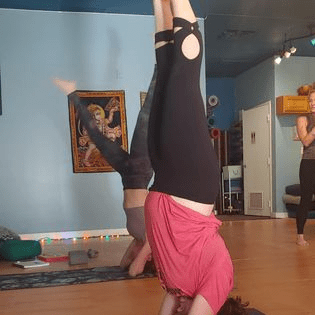
It’s a dreary Sunday, and I’m sitting at my favorite local coffee shop reading about chakras and sipping on mint tea.  I’m aware that if you saw my book titled Chakras for Beginners, you might think I was a little strange or new-agey.  But I’m preparing to teach a Heart Chakra yoga class/workshop.  I’m reading up on the chakras so I have a bit more insight to share with my students.  You see, aside from being a teacher of children, I’m also a teacher of yoga.  I received my certification this year, the year I turned 50.  Becoming a yoga teacher has been something I’ve wanted to do for years, and now I’m doing it.  I am living my dream, so to speak.  As the owner of my yoga studio says, “We have the best job ever.  We get to make people feel better.”  I don’t take this job lightly.

I started doing yoga officially when I was 17. I stumbled across an article with ten yoga poses in Seventeen magazine.  I cut the article out and did these poses every night before bed.  I couldn’t articulate the effect yoga had on me at the time, but I knew that I was calmer.  I slept better.  And I liked doing the poses.  I never told anyone that I was practicing yoga, but even as a teen, yoga was having a positive impact on my life.

Prior to my teenage foray into yoga, I’d been doing yoga for years and didn’t know it.  I started gymnastics at the age of five, and before practice, we’d stretch.  The stretches were yoga poses.  As a kid, I was also a runner.  Before practice, we’d stretch.  You guessed it — the stretches were yoga poses.  So I grew up with an appreciation for stretching as a prelude to any physical activity.  It wasn’t until my 30s or 40s when I realized that yoga itself was a physical activity that also settled the mind.  I began to see the positive benefits to the practice. 

When I was in my 30s, I was busy raising my two children.  I attended classes sporadically as my schedule would permit or put on a yoga video from time to time.  I loved it, but my focus was more on work and kids.  In my 40s, I started attending Yoga in the Vineyard on a regular basis.  This combined several of my great loves — yoga, wine, and socializing with friends.  Finally, about five or six years ago when I was going through a tough time, a friend of mine took me to her yoga studio in Olathe.  I attended classes here occasionally for years.  I loved this studio immediately with its chill vibes and colorful sun mural.  I enjoyed attending classes, but again, I was busy with work and kids. And during this time, I had a child who was fighting cancer.  So my priority was her care, not my own self care. 

Then the pandemic hit.  I knew the owner of my studio, as an independent business owner, was likely struggling to stay afloat.  So I bought a package of classes and eventually became a regular studio member.  I did yoga virtually, as I was able, to help her out and to care for myself as I was struggling, too.  Near the beginning of the pandemic, I lost my sweet daughter to cancer.  Afterward, I did yoga even more.  Yoga was my respite.  My practice allowed me to step out of my head and out of my grief for an hour at a time.  I say this in complete seriousness:  Yoga saved my life.  The practice of breathing and stretching and being present helped me have moments of peace during my sadness.  In fact, it still does.

Last fall, I talked to my teacher, the owner of my yoga studio,  about her teacher training classes.  I knew this was somewhat impractical.  What would a person my age do with a yoga teacher certification?  I didn’t know what my plan was, but I did know I wanted to learn more about the practice of yoga even if it was just for the sake of learning.  I talked a friend of mine into joining me, and we embarked on a 200 hour program to become yoga instructors.  In February, we “graduated.”  And within a month, a class opened up at our studio.  My friend and I now take turns teaching a Monday night restorative yoga class.  In addition, I teach yoga to a group of co-workers.  And I’ve booked a couple of other yoga gigs as well.  I’ve even done a bit of yoga with my students at school.

The importance of this journey to me is not only that I pursued my love of yoga, but that I pursued SOMETHING.  As I age, I try not to take a passive role in my life.  I believe in constantly learning and striving and growing.  To me, becoming a yoga instructor is more than just teaching yoga.  It’s about running towards life, trying new things, and letting the world know that age is not a deterrent from accomplishing goals.  At the end of the day, I know I’m stronger — inside and out — for delving a bit deeper into the practice of yoga. 

“Yoga is not about touching your toes,

it’s about what you learn on the way down.”

Jigar Gor